Overview

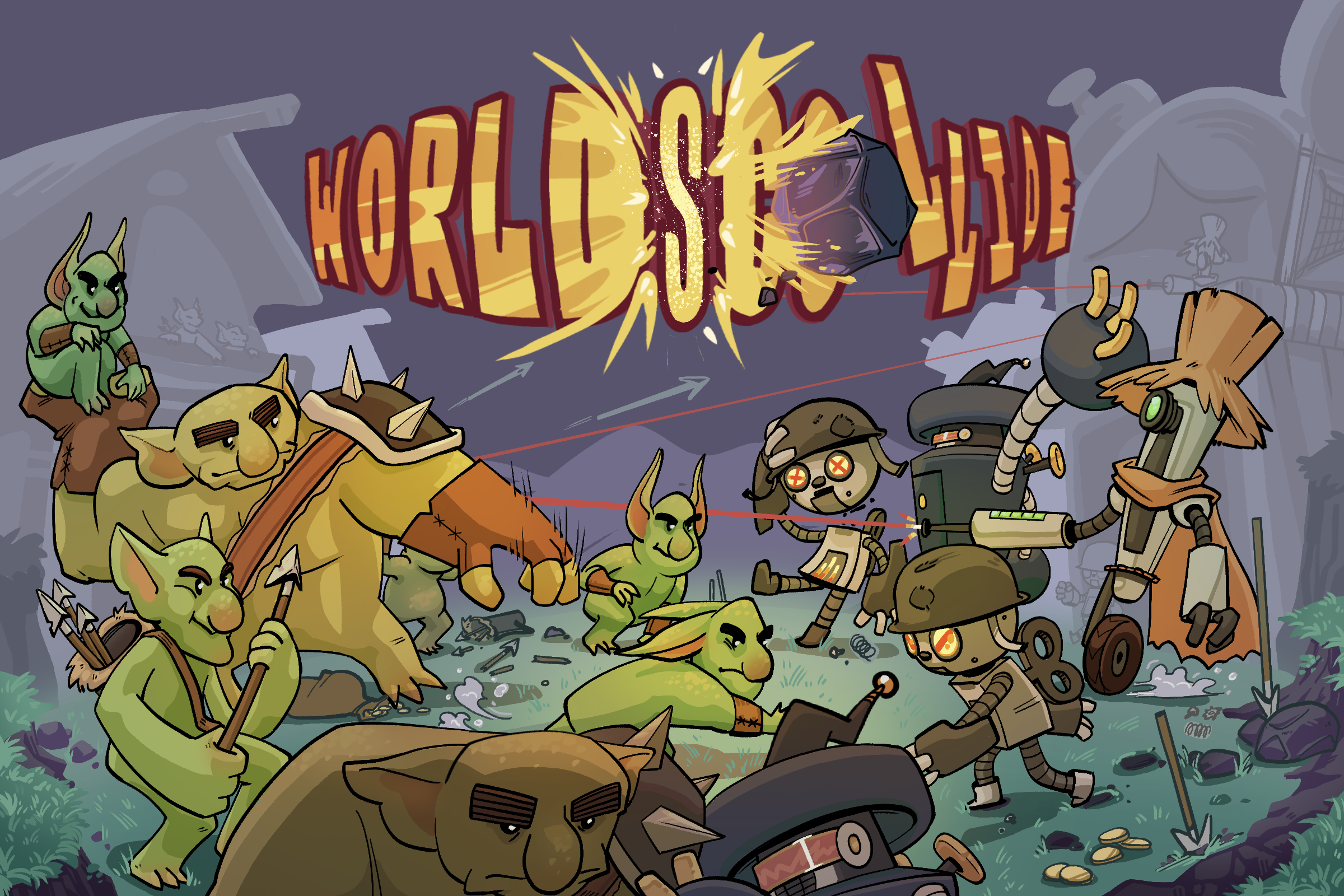
Welcome to Worlds Collide! The inaugural title of Black Swan Studios, a group of 18 student developers operating out of West Lafayette Indiana.

Worlds Collide is a simplified RTS with roots in Blizzard-like gameplay

Play how you please. Anything is possible between army selection, branching upgrades, evolving terrain, and the infinite strategies and counterstrategies integral to RTS gameplay!

Approach-ability is key. Simplified army composition and mechanics drastically lower the boundaries of play (an unfortunate staple of RTS franchises).

Interact with the battlefield like never before. Featuring an interactable and reactive environment, players will shape the battlefield through construction and conquest.

Easy to pick up and hard to master, watch as your army and the world around you evolve and adapt to each real time decision.

Contributors

The amazing team at Black Swan Studios

Noor Amin - Primary Advisor

Carlos Morales - Business Documentation Advisor

Jake Bell - Marketing Advisor

My Role

Studio Lead

Ownership Items

Creative Lead

Creative Process

Tools
Confluence
GIMP
Jira
Microsoft Suite
Non-Games
Unreal
C++

A brief History of Real Time Strategy

The name 'Real Time Strategy' (or RTS) was created by Brett Sperry to distinguish Dune 2's fast paced "real time play" from more traditional Turn-based strategy games, the standard format at the time (Source: RTS Wikipedia). From here the genre diverged a bit. Games like Age of Empires utilized the format's build diversity and cinematic qualities to create player-driven historical emulators within a city building shell that entranced experience driven players around the world. Meanwhile, games like Warcraft and Starcraft capitalized on oppositional problem solving and economy management. The result being a high skill ceiling, competitive, and fast paced multiplayer experience that took E-sports by storm. Many title's since have been inspired by this chapter in RTS history. For example, a breakout mod on Warcraft III map "Defense of the Ancients" was so successful it ascended the platform and became DOTA, the first true MOBA. While DOTA remains a juggernaut in its own right it also became the inspiration for current industry leader and E-sports phenomenon League of Legends. Decades later it has inspired another title: Worlds Collide!

Problem Statement

    Real Time Strategy (RTS), like Blizzard's Starcraft II, remain one of the most prolific games genre's and maintain a devoted core of players. However, high skill barrier often dissuade new players before they have the opportunity to unlock the full experience. As a result recent releases such as Stormgate and Tempest Rising have found varying success among traditional RTS crowds, but have struggled to reach new audiences.

The Approach

A quick note!
Mechanical Complexity - created when a mechanic requires players to interact with multiple elements or inputs in order to participate in the intended game-play experience. This idea is inspired by Ben Brode's idea of depth vs. complexity.

    We began by conducting a case study of Starcraft II. We separated all directly implemented mechanics - setting aside implied mechanics such as micro and macro - then ranked each depending on its mechanical complexity. What we found was that nearly every aspect of the game overlapped with a branching inventory system that required a heavy dependency on hotkeys and rendered many interactions several inputs away from a given game state.

    Watching veteran players interact with these systems it showed a level of memorization and muscle memory that would set a high boundary for experienced players looking to pick up the game. As a result, new players weren't able to interact with the game at the same pace as experienced players.

Average actions per minute in Starcraft II

Approach and Inspiration

    Because the branching inventory itself provides build diversity and is to RTS gameplay, we decided that the system itself is essential. So instead of replacing it we set out on designing a tree that was much more simplified. After brainstorming, testing, and adjusting for scope - our final list of high impact mechanics changes are listed below:
  1. Army Composition Drafting - League of Legends rune pages, Warhammer 40k army building
  2. Streamlined Tech Trees - Bloons: tower defense
  3. Crowd Based Combat - Bad North, Starcraft II "Slug fests", Warhammer 40k
  4. Terrain Manipulation - Minecraft, Fortnite
  5. Passive Production - Clash of Clans
  6. Art Direction and Lore- Clash of Clans, Warhammer 40k

Army Composition Drafting

After being placed in a match players will select their army, their selection will then be shared with each other. Before the game begins each player must select 5 units or structures from a pool of all army units/structures. Only those structures and one Town Hall will be available to them during the match.

Streamlined Tech Trees

Based on the traditional RTS feel and build diversity of Starcraft II the simplified system implements the fast-paced specialization of Bloons TD and, in combination with crowd based combat, an endgame inspired by Warhammer 40k.

Crowd Based Combat

Likely the most controversial change, troops are now controlled in a group called a "unit" designated by spawning structure. Doing so creates a more approachable control schematic and incentivizes more cinimatic, all-in combat.

Terrain Manipultion

Compete on an ever-evolving battlefield, build a fortress or tear one down! Large attacks will crumble the arena around you while players terraform reach new areas and expand their empire.

Passive Prodution

Town halls and other structures will passively provide passive income fueling your armies economy. The twist... higher levels will unlock important upgrades that can directly impact the battlefield. When considered alongside unit structures - army selection can become quite a balancing act.

Art Direction and Lore

The Worlds Collide Universe is unapologetically cartoonish and explosive, a stark contrast to a distopian struggle for power building just under the surface.

Ownership Items

1. The Game Design Document - Google drive and Confluence

    A living document, created prior to team formation and containing info (or links to the info) for all aspects of game design and development

While I am unable to provide the full GDD out of respect to the team and our project, the index of the work created is below

2. Black Swan Membership/Outsourcing Contracts

    Created as a composite contract to communicate roles, expectations, and terms of engagement at all levels and roles within Black Swan

3. Design Backlog - Jira

    An essential part of development, I lead conversation fleshing out our backlog during the "backlog jam", updated items, and assigned weekly tasks.

4. Asset backlogs - Google Drive and Jira

    Created by collaborating with team members and outsourcing agents I created several backlogs containing very specific tasks and completion goals.

    In the case of outsourcing agents these tasks were translated into timelines which were reflected in their contracts. An example of our animations backlog and its reflection in Jira are both below.

5. Publishing Pitch Deck

    Another Living document created as one of our initial project artifacts. The publishing deck is used, at the moment, as a representation of our team and our project in professional settings outside of the studio.

Takaways...

  • Communication is key: With a team of ~20 devs communication was never easy. As head of the design team the crunch was even greater due to the impact of our decisions and work across every team. Minor miscommunications almost always resulted in major blockage and often backtracking. To address this we distributed ownership of our living documents to ensure continuous upkeep, embedded design members in each team for easy clarification, continuously refined non-living documents, and addressed overall communication weekly at our design meetings. Although results weren't perfect we were able to intercept and course correct most major miscommunications in a timely and effective manor.

  • Design Roadmap: Often when discussing designs with programmers granular details would become far more impactful than expected. In an effort to get ahead of any confusion, I began catering our design focus to refine or revisit systems just before implementation. This also meant maintaining continuous contact with programmers to update a holistic roadmap and answer any questions.

  • Finding What Makes Black Swan: As creative lead it was easy to make something that came naturally to me. But as a team member it was readily apparent that was not what was needed. Through open forum conversation, consistent design meetings, and constant iteration; I was slowly able to form my thinking to making a product that was representative of our whole team and was cohesive to the ideas and design direction of my teammates as well.

  • Keeping the Vision: With this being my first time in a leadership role pursuing a project this large it became apparent very quickly that the promotion of our goals was more important than ever. With new ideas flying every direction, each team setting their own sprints, and a very limited timeline, a prioritized backlog and consistent revaluation were key.

Return To Home